Conveying is often the last system specified on a processing line and the first to cause problems. This guide covers what actually determines conveyor performance: belt type selection for your product, IP washdown ratings and what they really cover, throughput matching across the line, and integration with freezing and glazing equipment. Includes the three questions to ask any conveyor supplier before you commit budget.
Conveying is often treated as the commodity purchase on a processing line. It is usually specified last, after the freezing and glazing equipment, and evaluated mostly on price and delivery time.
This is a mistake. Conveyors touch product at more points than almost any other machine on the line, and they are the single most common source of unplanned downtime and hygiene audit failures in food and seafood processing. A belt that traps moisture, a frame that cannot be cleaned properly, or a drive system that cannot match the speed of the freezer downstream will limit the performance of every other piece of equipment you have invested in.
This guide covers what actually matters when specifying conveyor systems for a food or seafood processing line: belt type, hygienic design, washdown ratings, throughput matching, and integration with freezing and glazing stages.
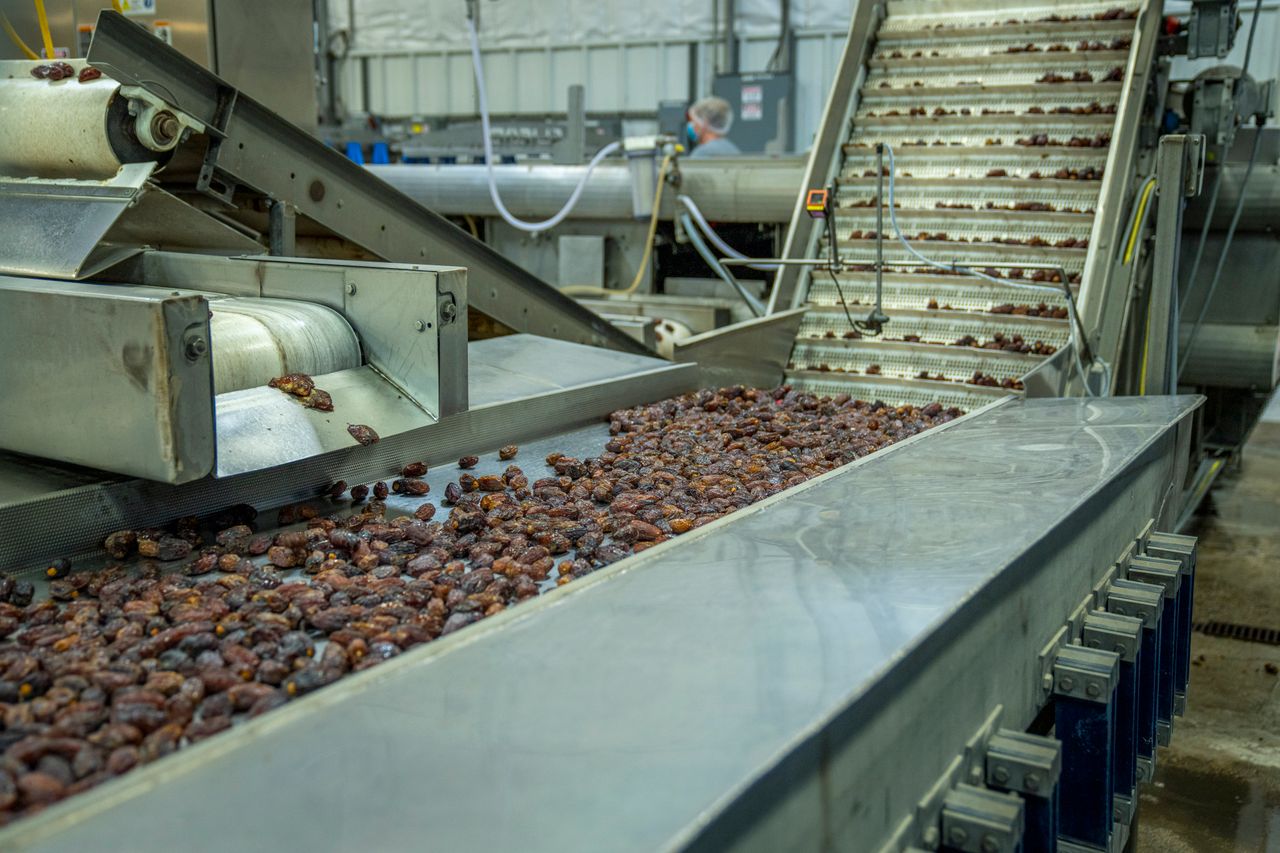
Belt selection is the first decision, and it should be driven by the product, not by what a supplier has in stock. Four belt types cover most food and seafood processing applications.
Modular plastic belt. The most common choice in wet washdown environments. Individual plastic links interlock to form the belt, which means a damaged section can be replaced without removing the entire belt, and most modular belts are designed for tool-free removal during cleaning. A good general-purpose choice for portioned product, packaged product, and most conveying between processing stages.
Wire mesh belt. Used where airflow through the belt matters, most commonly at the infeed and outfeed of IQF freezing systems and in chilling applications. Open mesh construction lets cold air pass through the product bed rather than only around it, which is part of why spiral freezer infeed conveyors are almost always wire mesh rather than solid belt.
Slat and honeycomb belt. Used for heavier product loads or where additional drainage is required beneath the product. Common on primary processing lines handling whole fish, whole birds, or larger cuts before portioning.
Roller conveyor. Used for crates, cases, and packaged product that does not contact the conveyor surface directly. Lower hygienic design requirement than product-contact belts, but still needs washdown-rated components if it sits inside a wash zone.
Every supplier will describe their conveyors as hygienic. The IP (Ingress Protection) rating system, defined in IEC 60529, is the actual specification that tells you whether that claim means anything.
An IP rating has two digits. The first rates protection against solid particles, where 6 means fully dust-tight. The second rates protection against water. Food processing environments typically specify components between IP65 and IP69K depending on how the zone is cleaned.
IP66. The most commonly specified rating for general food plant conveyors. Suitable for standard daily hose-down cleaning in produce handling, canning, and light processing environments.
IP69K. The highest rating, required wherever high-pressure, high-temperature CIP or foam-and-rinse sanitation is used, which covers most meat, poultry, dairy, and seafood processing lines. Tested to withstand roughly 80°C water at 80 to 100 bar applied at close range from multiple angles.
One detail that catches buyers out: the IP rating applies to individual electrical and mechanical components — motors, drives, sensors, control enclosures — not to the conveyor frame as a whole. A frame built from the correct grade of stainless steel does not make the motor on that conveyor washdown-rated. Every powered component in a wash zone needs its own appropriate IP rating specified individually.
Beyond IP ratings, hygienic frame design follows a consistent set of principles across EHEDG guidance: open frame construction rather than boxed sections that trap moisture, crevice-free welds ground and polished to a food-contact finish, self-draining surfaces with no flat horizontal ledges, and tool-free access for daily belt removal and cleaning. These design features determine how long a full sanitation cycle actually takes, which is a real operating cost most buyers do not evaluate at the specification stage.
A conveyor specified in isolation, without reference to the equipment on either side of it, is one of the most common causes of an underperforming processing line. Belt speed, product spacing, and the throughput capacity of upstream and downstream equipment all have to be calculated together.
Belt speed vs. product spacing. Running a belt faster to increase throughput only works if product spacing and orientation control keep pace. Beyond a certain speed, product placement accuracy degrades and downstream equipment receives inconsistent input.
Matching to the constraining stage. The conveyor's rated capacity should match the throughput of the slowest stage on the line, not the fastest. A conveyor rated well above the freezer or glazing system it feeds adds cost without adding usable capacity.
Accumulation and buffering. Where upstream and downstream stages run at genuinely different natural rates — for example manual inspection feeding an automated freezer — an accumulation conveyor section may be the correct answer rather than forcing every stage to run at identical speed.
Conveyors rarely operate as standalone equipment on a processing line. The infeed and outfeed conveying at each processing stage has to physically and electronically integrate with the equipment it connects to.
For IQF spiral freezers, infeed conveyor speed and product spacing directly affect freezer loading consistency, which in turn affects core temperature uniformity across a batch. A conveyor calibrated independently of the freezer's actual infeed requirements produces inconsistent freezing results even if the freezer itself is correctly specified.
Elevation changes between conveyor sections, belt-to-belt transitions, and product orientation control at transfer points all require deliberate engineering rather than simple proximity. Each transfer point where product moves from one conveyor to another, or from a conveyor into a glazing system or freezer, is a point where product can be damaged, misaligned, or where hygiene risk increases if the transfer geometry is not properly designed.
Question 1. What IP rating is specified for every powered component in the wash zone, not just the frame material? Get the IP rating for each motor, drive, and sensor individually. A stainless frame with an IP54 motor is not a washdown-rated conveyor.
Question 2. What is the rated throughput at the actual product weight and spacing you will run, not the manufacturer's generic maximum? Maximum rated speed figures are usually tested under ideal conditions. Ask for throughput data at your specific product profile.
Question 3. How long does a full sanitation cycle take on this conveyor, and what tools, if any, are required? Sanitation time is a genuine daily operating cost. Tool-free belt removal and open-frame design directly reduce it.
It depends on the cleaning regime in that zone. IP66 is the most commonly specified rating for standard daily washdown in produce handling and light processing. IP69K, the highest rating, is required wherever high-pressure, high-temperature CIP or foam sanitation is used, which covers most meat, poultry, dairy, and seafood processing lines. The rating applies to individual components such as motors, drives, and sensors, not to the frame as a whole, so each powered part in the wash zone needs its own rating specified.
Modular plastic belt is built from interlocking plastic links, allowing tool-free removal and section replacement, and is the most common choice for general wet washdown conveying. Wire mesh belt has an open construction that allows airflow through the product bed, which is why it is standard at the infeed and outfeed of IQF freezing systems and in chilling applications where air needs to reach the product from below as well as above.
Conveyor throughput should be specified to match the slowest stage on the line, not the fastest, since a conveyor rated well above the capacity of the freezer or glazing system it feeds adds cost without adding usable output. Where upstream and downstream stages run at genuinely different natural rates, an accumulation or buffering conveyor section can bridge the difference rather than forcing every stage to the same speed.
Infeed conveyor speed and product spacing directly affect how evenly product loads into an IQF spiral freezer, which in turn affects core temperature consistency across a batch. A conveyor calibrated independently of the freezer's actual infeed requirements can produce inconsistent freezing results even when the freezer itself is correctly specified and installed.
EHEDG guidance for hygienic conveyor design covers open frame construction that avoids trapping moisture, crevice-free welds ground to a food-contact finish, self-draining surfaces with no flat horizontal ledges, and tool-free access for daily cleaning. EHEDG guidelines are built to actively support the EU Machinery Directive 2006/42/EC, which governs machinery safety requirements across the EU market.
Ask for the IP rating of every individual powered component in the wash zone, not just the frame material. Ask for rated throughput at your actual product weight and spacing, not the manufacturer's generic maximum figure. And ask how long a full sanitation cycle takes and what tools, if any, are required, since sanitation time is a genuine daily operating cost that tool-free belt removal directly reduces.

Havmek delivers end-to-end seafood processing systems built on engineering excellence and sustainable innovation. We combine India’s seafood processing expertise with Europe’s precision engineering, compliance standards, and sustainability ethos to deliver robust, scalable, and hygienic solutions. The solutions cover every stage of the seafood value chain; from grading and glazing to IQF freezing, packaging, and cold storage. All systems are designed around plant layout, throughput requirements, and export-grade quality standards with certified to ISO 9001, ISO 14001, and ISO 45001.