Most processing line problems that get blamed on a specific machine actually start at the handoff between machines. This article covers what happens at a transfer point, why drop height and speed mismatches cause damage and spacing problems that show up downstream, why transfer zones are a common hygiene blind spot, and why transfer point design is a reliable signal of whether a line was engineered as a system or assembled from separately specified parts.
A processing line is usually evaluated machine by machine: is the freezer rated correctly, is the conveyor belt the right material, is the glazing system dialled in. What gets far less scrutiny is the handoff between each of those machines, the point where product leaves one piece of equipment and arrives at the next. That handoff is a transfer point, and it is where a surprising share of line problems actually originate.
This article covers what happens at a transfer point, why the details that seem minor there, drop height, speed matching, orientation control, are not minor at all, and why transfer point design is one of the clearest signals of whether a line was engineered as a system or assembled from individually correct parts.
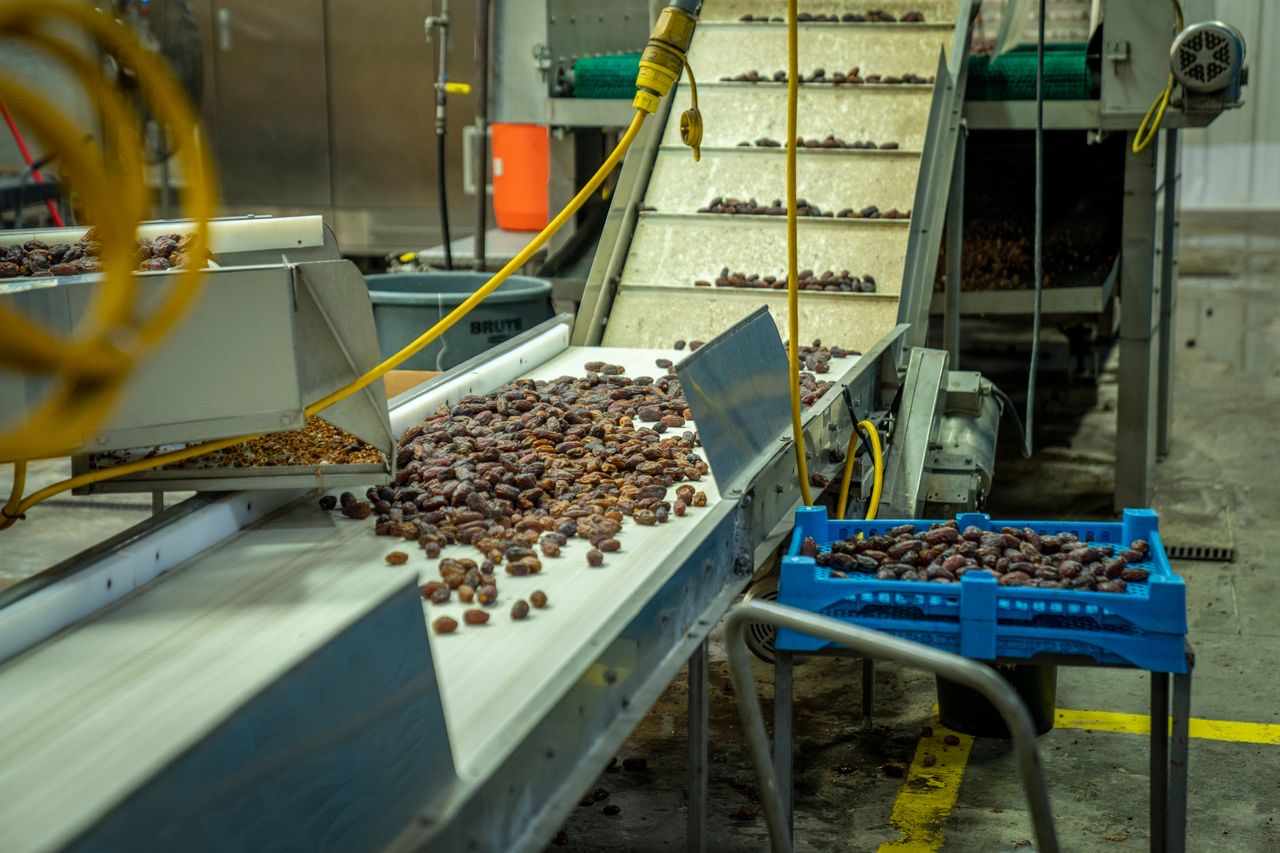
A transfer point is any location where product changes carrier: belt to belt, conveyor to freezer infeed, freezer outfeed to glazing system, glazing system to packaging line. Three things happen simultaneously at every one of these points, whether or not anyone designed for them.
None of these three things are visible on a general arrangement drawing that shows conveyors as connected boxes. They only show up once the line is running.
Product arriving at a transfer point with any vertical drop lands with a small impact, and that impact has a real effect depending on what is being processed. Delicate product, small shrimp, thin fillets, soft-textured cuts, can bruise, deform, or shift out of the orientation a downstream machine needs. Even robust product can bounce or slide on landing, which reintroduces the spacing problem a well-designed line was supposed to have already solved upstream.
The fix is rarely to eliminate elevation changes entirely, since some are structurally necessary. It is to control the landing: matched belt speeds either side of the drop, a short transition section rather than a sharp step, and guide geometry that re-establishes orientation immediately after the handoff rather than several metres downstream.
Two conveyors can each be individually correct, rated for the right throughput, built to the right hygienic standard, and still create a problem the moment they meet, if their running speeds are not matched at the handoff.
A downstream belt running faster than the upstream belt stretches product spacing apart. A downstream belt running slower bunches product together. Either outcome changes the input pattern that the next piece of equipment on the line was designed around. An IQF spiral freezer calibrated for evenly spaced single-layer product does not perform to specification if the conveying feeding it is delivering clumped or gapped product because of an unmanaged speed mismatch two transfer points upstream.
This is why speed matching at every transfer point has to be part of the line specification, not something adjusted after commissioning once a problem is noticed.
Transfer points are also where hygienic design most often breaks down, for a simple reason: the geometry at a handoff is inherently more complex than the geometry of a single conveyor run, and complex geometry is harder to keep clean. EHEDG hygienic design guidance requires self-draining surfaces with no flat horizontal ledges and crevice-free construction on any surface product or product residue can reach, exactly the kind of surface that a poorly designed transfer chute or drip tray creates if it is treated as an afterthought rather than as part of the core design.
A frame that is individually EHEDG-compliant at every machine can still create a non-compliant condition at the point where two compliant machines meet, if the transfer geometry between them was not designed to the same standard. Debris and moisture accumulate exactly where two pieces of equipment were bolted together without a validated cleaning path through the gap.
An equipment supplier is responsible for the performance of their own machine, measured at its own inlet and outlet. Speed matching, drop height, and the geometry of the handoff to whatever sits on either side of it are, by definition, outside any single machine's own specification, they belong to the space between machines, which nobody owns unless someone is designing the line as a whole.
An engineering partner treats the transfer points as part of the specification from the start: belt speeds set relative to each other across the full line, elevation changes minimised or properly transitioned, and hygienic design carried through the handoffs, not just the machines either side of them. This is the same distinction covered in more depth in our companion guide,
How to Spec a Seafood Processing Line: 7 Questions to Ask Before You Buy, and it is one of the more reliable, low-visibility signals of whether a line was actually engineered end to end.
A transfer point is any location where product moves from one piece of equipment to the next, belt to belt, conveyor to freezer infeed, freezer outfeed to glazing system, or glazing system to packaging line. At every transfer point, product typically experiences an elevation change, a possible belt speed change, and a loss of the guided control that kept it oriented correctly on the previous conveyor.
Even a small vertical drop between conveyors causes an impact on landing that can bruise or deform delicate product, or cause robust product to bounce or slide out of position. This reintroduces spacing and orientation problems that a well-designed upstream line was intended to have already solved, and can affect how consistently downstream equipment like an IQF freezer performs.
A downstream conveyor running faster than the upstream conveyor stretches the spacing between product pieces apart. A downstream conveyor running slower bunches product together. Either outcome changes the input pattern that the next machine on the line, such as an IQF spiral freezer, was calibrated to expect, which can reduce freezing consistency even when the freezer itself is correctly specified.
Transfer points have inherently more complex geometry than a single conveyor run, which makes them harder to keep clean. EHEDG hygienic design guidance requires self-draining, crevice-free surfaces on anything product or residue can reach. A transfer chute or drip tray designed as an afterthought, rather than to the same standard as the machines either side of it, commonly creates the exact conditions EHEDG design principles are meant to prevent.
An equipment supplier is typically responsible for their own machine's performance at its own inlet and outlet, not the handoff to whatever sits on either side of it. An engineering partner specifies transfer points, belt speed matching, elevation transitions, and hygienic geometry through the handoffs, as part of the overall line design from the outset, rather than leaving them for site teams to resolve after installation.

Havmek delivers end-to-end seafood processing systems built on engineering excellence and sustainable innovation. We combine India’s seafood processing expertise with Europe’s precision engineering, compliance standards, and sustainability ethos to deliver robust, scalable, and hygienic solutions. The solutions cover every stage of the seafood value chain; from grading and glazing to IQF freezing, packaging, and cold storage. All systems are designed around plant layout, throughput requirements, and export-grade quality standards with certified to ISO 9001, ISO 14001, and ISO 45001.